Transcript
Announcer:
Welcome to CE on ReachMD. This activity is provided byMedcon International and is part of our MinuteCE curriculum.
Prior to beginning the activity, please be sure to review the faculty and commercial support disclosure statements as well as the learning objectives.
Dr. Bauersachs:
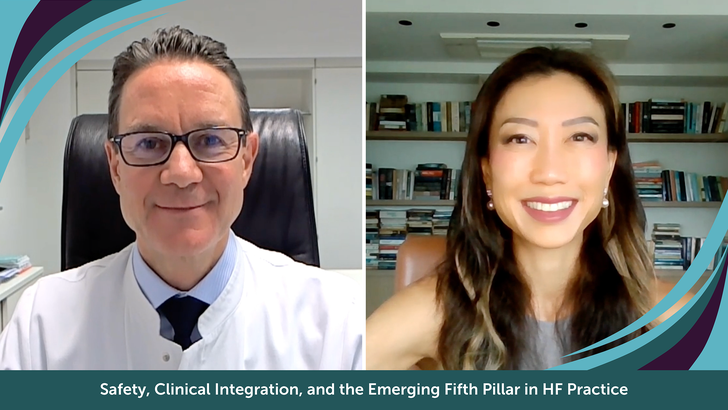
This is CE on ReachMD. And I'm Dr. Johann Bauersachs. Here with me today is Dr. Carolyn Lam. In this episode, we'll talk about the safety and tolerability profile of sGC stimulators. We'll also go one step further and discuss how to implement this therapy in ambulatory patients with heart failure with reduced ejection fraction, HFrEF, who are at high risk despite quadruple guideline-directed medical therapy or device therapy.
Carolyn, what can you tell us about recent safety data from VICTOR and the pooled analysis of VICTOR and VICTORIA?
Dr. Lam:
Well, I think it is good news. Basically we have a drug in vericiguat that is safe and very well tolerated. Now, the thing that we all worry about when we talk about sGC stimulation is hypotension, and we were very careful in the up-titration scheme and so on when we tested it in both VICTORIA and VICTOR, and yet even in patients recently hospitalized, so the more high-risk, unstable patients, and in VICTOR and even in subgroups who were older or on concurrent ARNI or who had renal impairment and so on—even in all those patients, hypotension was not a significant issue. In fact, many patients who experienced it can either be scaled back in the dose and continued and still able to therefore continue in their therapy. And at the end of it, more than 90% are able to tolerate the target dose at 1 year. So this is not a significant issue.
And if we talk about the other things that we worry about when we up-titrate GDMT, we're always worried about creatinine, potassium, and so on. Well, guess what? In these trials you are allowed in with the lowest eGFR cut point in all the other trials: 15. You can get in as long as your eGFR is above 15. And even in this broad spectrum of low eGFR, there was no signal of worrying about worsening AKI or hyperkalemia or hypokalemia. We don't need to worry about that with vericiguat. So it is good news, a very well-tolerated and safe drug.
Dr. Bauersachs:
Thank you so much for pointing this out. I think it's also important to mention that it's an implementation-friendly regimen. It's only once-daily oral dosing and straightforward titration, and so this appears to be a medication that we can easily use in clinical practice.
And I think it's also important to mention the VELOCITY trial. So in this study they compared the traditional dosing scheme with 2.5 mg, then go to 5 mg, then go to 10 mg of vericiguat. But in VELOCITY they started 5 mg and 10 mg, and it turned out that in 95% of the patients, you can easily start with 5 mg. You don't have to go through this additional step of 2.5 mg. And especially in patients that have 100 mmHg systolic blood pressure or more, they tolerate the 5 mg.
And I think this is also very important news for our patients. And so we have the safety, we have the easy way of application, and we have the benefit. That means that we have a reduction of mortality and also heart failure hospitalization or the totality of heart failure events. And therefore, this picture supports the long-term use of vericiguat as a durable mortality-reducing pillar, perhaps the fifth pillar, and not only a short-term bridge after worsening events. So I think with these data we have now confidence that we can use vericiguat in clinical practice, or what do you think, Carolyn?
Dr. Lam:
I agree. Because the totality of the evidence from VICTORIA and VICTOR pool really showed that the number needed to treat is only 37. Only 37 to prevent a cardiovascular death or heart failure hospitalization in that pooled population, which includes HFrEF across the spectrum of presentation. So I do think that we have another effective class of medication that we need to consider in our patients with HFrEF who do remain at risk of important events despite being on guideline-directed medical therapy. And so now it's up to us to recognize when these patients need it, to recognize that a lingering high natriuretic peptide level is a problem, to recognize that if they're still requiring higher doses of oral diuretics, that is a problem, and frankly, not to wait for a catastrophic event before really optimizing their medical and device therapies.
Dr. Bauersachs:
Nothing to add. Thank you so much, Carolyn, for the excellent presentation and discussion, and we thank the audience for joining us today. See you next time.
Announcer:
You have been listening to CE on ReachMD. This activity is provided by Medcon International and is part of our MinuteCE curriculum.
To receive your free CE credit, or to download this activity, go to ReachMD.com/CME. Thank you for listening.
 This enduring activity is accredited by the European Board for Accreditation of Continuing Education for Health Professional (EBAC®) for 45-minutes of effective education time.